At St. Francis House, we’re undergoing a major transformation—both in structure and in spirit. With a complete renovation of our main shelter at 39 Boylston Street, we are reshaping how we serve those experiencing homelessness and poverty in downtown Boston.
This is more than a construction project. Vice President of Strategy & Program Initiatives Andrea Farina says, “To really live our vision for our guests, we knew we would need to make structural changes.”
Building a Space That Reflects Our Mission
“Our philosophy of care is person-centered, trauma-informed, and recovery-oriented,” Andrea explains. “Those were things we had always done, but we had not labeled it or embedded it in all that we do.”
That began to change in 2018, when the organization began preparing for a capital campaign and took a hard look at how its physical environment either supported, or stood in the way of, its mission.
“Our long-ago converted office building was never designed to be a human services agency. Our physical spaces had been getting in our way for a long time,” Andrea says. “Our old building served us well but was worn down and disconnected in ways that made it challenging for our staff to do their best work.”
Guests entering the facility were met with loud noise, harsh corners, and limited direction. “It was really hard to establish a feeling of relief when people walked in the door, which was our goal,” she explains. “We want our guests to be able to walk into St. Francis House and exhale; feel like this is a welcoming community and not an institution.”
A Trauma-Informed Approach to Design
Drawing from best practices in trauma-informed design, St. Francis House partnered with The Architectural Team (TAT) to ensure the renovated space would reflect the values of dignity, safety, and healing.
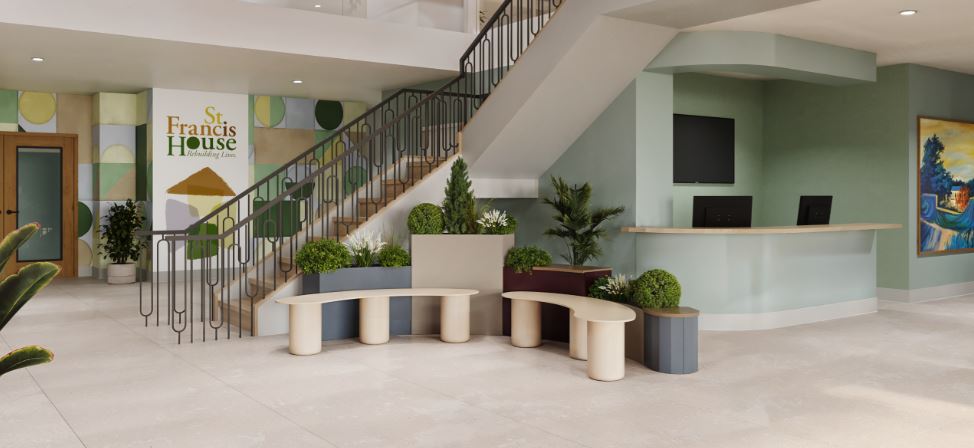
“We were very intentional about colors and furnishings in order to send the message that this is a place of dignity, it’s a respectful environment,” Andrea says. “Furnishings have round edges, not square edges. The space will have natural colors—colors brought in from outdoors.”
In addition, spaces are designed to offer clear visibility and intuitive wayfinding. “The new space will have large areas where a guest can see everything around them so that they know they are safe.”
 Redesigning the Guest Experience
One of the most transformative changes involves how services—especially meals—are delivered.
“In practice, we wanted to design both our space and our programs in such a way that we avoid lining up for any service,” Andrea says. “As soon as people line up, they are in a stressful situation. There’s someone in front of them, someone behind them… and we wanted to limit that.”
In the newly designed shelter, food service will now be spread out over longer time blocks instead of served at rigid times, allowing guests to eat at their own pace.
“There was no way to make this happen in our old kitchen and dining area. We did not have the capacity in our old kitchen to extend hours, but we will now.”
Guests will also see a change in how meals are presented. “For years we have had to serve meals in sectioned trays, because we couldn’t manage distributing and washing plates—it just wasn’t going to work in our space. Unfortunately, trays are very institutional, which has gone against our goal of being a dignified community center.”
The new kitchen design allows for a whole new model: plates, choices, and a more human dining experience.
Centering Autonomy and Respect
At the heart of the renovation is a belief that everyone who walks through our doors deserves to feel seen, heard, and valued.
“Autonomy and choice are really important in terms of trauma-informed care,” Andrea says. “It centers that person in having control over their life.”
“Our work is so much more than putting food in bellies,” she adds. “It’s about showing people there are things they can control. It reminds them that they are a person of value, so they are more likely to invest in themselves.”
What’s Ahead
Construction began in August 2024, with the first two floors set to be completed by early August 2025, and the full renovation finished by early December 2025.
“The whole idea for the renovation started on a white board,” Andrea recalls. “We said, let’s start with what we want and what we will need to make that happen.”
“We let the mission drive us and then integrated the expertise that we got from the architectural team and made tweaks as needed. We held numerous exploratory meetings and workshops with staff, and got input from guests, as we iterated toward our final design over the years. This inclusive planning gave us an opportunity to make the most of our building and to gradually refine our day to day experience to fully live our mission.”
As St. Francis House moves into its next chapter, these new spaces will help the staff do what they’ve always done—only better. Because at St. Francis House, healing begins the moment you walk through the door.